
Certified Business
Canadian Owned
With over 10,000 orders

When anyone in your organization works at heights, it's critical to have a formal fall protection plan and rescue procedures.
When every second counts, preparation can be the difference between a rescue and a tragedy. Whether you’re maintaining a transmission tower in BC’s rugged interior or working wind installations in Alberta, your fall protection plan must be airtight, and your rescue protocols bulletproof.
At Height Works, we build systems that don’t just meet the code. They beat the clock.
A Fall Protection Plan outlines how workers are protected from falling hazards when working at height involves more than just a checklist; it is a legally required document under CSA Z259 and OHS Regulations. These regulations must be tailored to each specific job site.
What to include:
This applies to each and every team member.
1. All general work at height activities,
2. And highly technical situations that should each have their own distinct and separate procedures written for each unique technical situation that may occur.

Not all rescue plans are created equal.
Passive Rescue Systems rely on fixed structures like self-rescue devices. Fast and hands-free, but not always enough.
Active Rescue Systems require a trained team to deploy gear such as:
Haul Kits
Auto-locking descenders
If your worker is unconscious, suspended in fall arrest, and waiting on a rope, how fast is your crew ready to respond?
At a minimum, your rescue protocol should include:
|
Equipment |
Use Case |
|
JAG Rescue Kit |
Rapid victim access & descent |
|
Petzl Podium Seat |
Comfort during prolonged hangs |
|
Haul Kits |
Mechanical advantage lifting |
|
Rope Access Hardware |
Anchors, carabiners, pulleys |
To remain compliant, your plan must align with:
CSA Z259.2.2, Z259.10, Z1006
OH&S Part 9 (Fall Protection), Section 141–158
BCWS or AER guidelines for high-risk energy zones
A rescue plan is only as good as the people who run it.
We recommend:
Every second matters. Drills build muscle memory.
When working at height in remote or high-risk environments like:
You need:
Safety delays are project delays. We help you stay both compliant and operational.
“Our team faced a rescue situation 65 feet above a pipeline crossing. The JAG system we purchased from Height Works worked flawlessly. Their training plan made the difference.”
— Bryce M., HSE Manager, Energy Services
“Height Works didn’t just sell us gear—they built our plan. They walked our team through it line by line. We passed our audit and now sleep better at night.”
— Laura S., Regional Safety Officer, Municipal Infrastructure BC
Do I need a rescue plan for every site?
Yes. A site-specific fall protection and rescue plan is legally required under most Canadian provincial OH&S regulations.
How often do I need to train my crew?
Annually at minimum, and after any near-miss or change in work location or scope.
What happens if we don’t have a rescue plan?
You’re exposing your team to high risk, and your company to liability, shutdowns, or fines.
What is the best rescue kit for remote fieldwork?
We recommend the JAG Rescue Kit for its compact form and fast deployment in solo or two-person rescues.
JAG Rescue Kit → For fast, efficient vertical rescue
Petzl Podium → For extended positioning
Derope T Descent Device → Multi-directional for complex use, this Derope T descent device includes: 6 ft. (1.8 m) vinyl covered wire rope sling, 5/8 in. (16 mm) autolocking carabiner, J-knife-KSOS, rescue/rope bag. Available in 5 rope lengths.
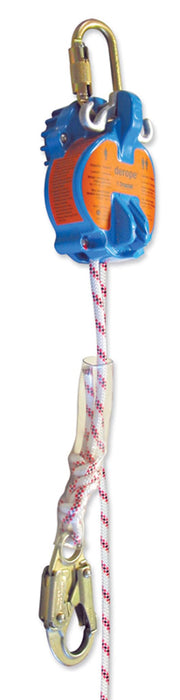
Fall Arrest Anchors → Temporary & permanent options
Don’t wait for the incident. Plan for it. Work with our Safety Experts
If you want to discover how to create a formal fall protection plan for working at heights for your organization, contact a fall protection safety expert at Height Works today!
{"one"=>"Select 2 or 3 items to compare", "other"=>"{{ count }} of 3 items selected"}