
Certified Business
Canadian Owned
With over 10,000 orders

In Canada, working at height is a constant across industries, from Alberta’s refineries to Manitoba’s grain silos and British Columbia’s wind farms. Each of these sectors faces one shared truth: gravity never takes a break.
Mounted fall protection systems are designed to make sure workers return home safe, every shift. They represent the evolution from basic harnesses and anchors, to fully engineered safety systems built to meet Canada’s most rigorous standards, including the CSA Z259 series.
With Canada’s fall protection market projected to reach US $170 million by 2030, and global growth trending near 7–9 percent annually, organizations are investing in engineered solutions that combine compliance, innovation, and operational reliability.
Every year, fall-related incidents remain a leading cause of workplace injury and fatality across Canadian worksites. Most occur not because of neglect — but because older, piecemeal systems cannot match modern job site complexity.
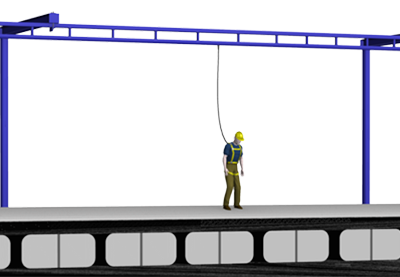
Mounted systems solve this gap by providing fixed, overhead, or equipment-integrated anchor points that protect workers without impeding workflow. Whether it’s a ceiling-mounted rail above a maintenance bay or a swing-arm system servicing a rooftop HVAC unit, these installations create continuous coverage, certified to CSA Z259 standards.
The result is safer, faster work. Downtime decreases. Confidence rises. Compliance becomes the natural outcome of design, not an afterthought.
A mounted fall protection system is a permanent or semi-permanent installation that anchors workers while allowing freedom of movement along a defined path. Unlike portable tripods or temporary lifelines, mounted systems are engineered for the long term, they become part of the facility’s safety infrastructure.
Typical configurations include:
Ceiling-Mounted Monorails — continuous rigid-rail tracks for fleet maintenance or manufacturing plants.
Column-Mounted Swing Arms — rotating systems that provide coverage over specific work zones.
A-Frame or Jib Systems — mobile yet mounted frames for truck or equipment servicing.
Equipment-Mounted Anchors — built directly onto cranes, trucks, or lifts for remote operations.

This fall protection D-ring provides reliable safety for your height access systems.
These systems support both fall-arrest and fall-restraint applications, offering a scalable approach for single or multiple users.
Safety in Canada doesn’t rely on guesswork, it’s codified through national and provincial regulations.
Most provinces require fall protection when work is performed at three metres (10 feet) or more, and compliance with the CSA Z259 series is considered best practice, often written directly into safety programs or tender requirements.
Key standards include:
CSA Z259.16 – Design of Active Fall-Protection Systems
CSA Z259.17 – Inspection and Maintenance of Fall-Protection Equipment
CSA Z259.15 – Anchorage Connectors and Systems
Mounted systems engineered and certified to these standards demonstrate structural integrity, tested anchor capacity, and documented inspection intervals.
Mounted systems come in many forms — each suited to a different environment, budget, and workflow.
|
System Type |
Description |
Ideal Applications |
|
Ceiling-Mounted Monorail |
Fixed rigid-rail track running overhead; enables full horizontal mobility. |
Fleet maintenance, aircraft hangars, and manufacturing. |
|
Travelling Bridge System |
Dual rails supporting a movable bridge; covers wide work areas. |
Vehicle bays, warehouse operations. |
|
Column-Mounted Swing Arm |
Rotating arm providing 180°–360° coverage; can support one or two users. |
Loading docks, fabrication facilities. |
|
Free-Standing Swing Arm |
Self-supporting unit with no building tie-in; relocatable base. |
Outdoor job sites, temporary plant maintenance. |
|
Fixed-Height A-Frame |
Permanent or semi-mobile; rigid overhead track with fixed height. |
Truck loading and maintenance. |
|
Adjustable-Height A-Frame |
Telescoping legs for variable clearance and reach. |
Heavy equipment service, wind-turbine assembly. |
|
Equipment-Mounted Anchor |
Mounted directly to machinery, vehicles, or cranes. |
Oil & gas, utilities, or mobile crews. |
|
Custom Engineered Systems |
Built to facility specifications and certified to CSA Z259.16. |
Hospitals, refineries, and infrastructure projects. |
Each design shares a single goal: keep the worker connected to a certified anchor at all times.
From commercial towers to bridge decks, construction remains the largest driver of fall protection demand. Mounted systems enable continuous coverage for trades and envelope work, helping companies stay compliant during multi-phase projects.
Mines introduce height hazards in headframes, conveyor systems, and maintenance platforms. Engineered anchors and monorails allow workers to move safely around equipment without additional scaffolding or downtime.
Corrosive conditions and remote access make oilfield safety complex. Mounted jib and portable rail systems rated for CSA Z259 loads deliver certified fall-protection for rig, tank, and pipeline maintenance.
Wind-turbine technicians rely on portable and mounted arrest systems for tower ascent, nacelle entry, and blade inspection. Lightweight aluminum rails and quick-mount anchors simplify field installation.
Facility managers prioritize zero downtime. Mounted rails and swing arms integrated into rooftops or ceiling structures provide safe access for HVAC, solar, or service crews without disrupting operations.
Designing a compliant mounted system requires precision not improvisation.
Engineering Factors to Consider:
Load Rating: Systems must sustain twice the maximum arrest force expected in a fall event.
Swing-Fall Prevention: Proper anchor alignment reduces lateral forces.
Material Selection: Galvanized steel for strength; aluminum for mobility; stainless steel for medical or corrosive environments.
Environmental Resistance: Coatings and sealed bearings protect against Canadian winters, ice, and salt exposure.
Integration: Compatible with self-retracting lifelines (SRLs), body harnesses, and energy absorbers.
Each system undergoes detailed structural review and load testing before certification — ensuring that every anchor, beam, and weld performs under stress.
A mounted system is only as safe as its inspection schedule.
Under CSA Z259.17, all fall-protection equipment — including mounted rails and anchors — must undergo:
Annual Inspections: Conducted by qualified professionals with written documentation.
Five-Year Recertifications: Full engineering review and re-testing to verify ongoing compliance.
User Pre-Use Checks: Visual inspections before each shift.
Partnering with our certified fall protection experts to ensure consistency and traceability. Digital tagging and cloud-based inspection logs are now common, allowing your to manage compliance across multiple sites and provinces.
Inspection is not an expense, it’s risk control. Every compliant inspection reduces the probability of both injury and liability.
Mounted fall-protection systems are an investment in longevity. Costs depend on system size, mobility, and engineering complexity.
Estimated Ranges:
Standard fixed-rail system: $10,000–$25,000 CAD per bay
Custom engineered installation: $25,000–$75,000 CAD+
Portable A-frame or jib system: $12,000–$20,000 CAD
Annual inspection & recertification: 5–10 percent of initial cost
For project-based work, temporary installations offer flexibility. Height Works provides swing arms, or portable rigid rails certified to CSA Z259, ideal for shutdowns, maintenance, or construction phases.
We recommend evaluating lifecycle value over price. An engineered, certified system reduces downtime, insurance costs, and compliance risk, delivering a measurable return on safety.
When a Calgary Hospital upgraded its rooftop HVAC units, the facilities team faced a complex problem: how to provide safe worker access without interrupting patient services.
Height Works engineers designed a ceiling-mounted rigid-rail system rated for dual users. The system integrated directly into the building’s steel structure and was certified to CSA Z259.16.
Results:
Zero service disruption during installation.
Reduced maintenance time by 40 percent.
Simplified annual inspection under Z259.17.
Full documentation for occupational health compliance audits.
This use case exemplifies how engineered systems support essential industries where uptime and safety share equal priority.
The next generation of fall protection is digital, data-driven, and adaptive.
Sensors embedded in anchors or SRLs provide real-time data on tension, shock load, and usage cycles. Supervisors can monitor system integrity remotely, reducing manual inspection hours.
AI analytics can now flag anchors nearing stress thresholds — allowing proactive recertification before failure occurs.
Lightweight, quick-connect bases and rail sections let companies reconfigure mounted systems across multiple sites — combining permanent safety with operational flexibility.
Virtual-reality (VR) modules simulate falls, helping workers understand harness fit, swing-fall angles, and system use before they step on site.
A fall-protection system is only as reliable as the team behind it. Before selecting a supplier or installer, ensure they meet these standards:
CSA-Certified Engineering — Designs reviewed by Canadian engineers under Z259.16.
Comprehensive Inspection Program — Annual and 5-year reviews documented and trackable.
Cross-Industry Expertise — Experience in mining, energy, hospitals, and infrastructure.
Local Footprint — Service and recertification capacity across Western Canada.
Training Support — On-site user orientation and documentation.
At Height Works Ltd., we partner with organizations across Alberta, British Columbia, and Manitoba to design, install, and maintain mounted systems built for longevity — not liability.
Mounted fall-protection systems define a higher standard for workplace safety in Canada. They combine engineering precision with regulatory integrity, creating systems that safeguard workers while supporting productivity.
From wind-turbine towers to hospital rooftops, every anchor, rail, and swing arm carries one promise to make sure everyone goes home safe.
When you choose a CSA-compliant, engineered system backed by certified inspection and training, you protect not just your crew, but your entire operation.
Protect every height. Every shift. With Height Works.
Ready to Get Started?
Book a CSA-Compliant System Consultation with one of our team members today.
{"one"=>"Select 2 or 3 items to compare", "other"=>"{{ count }} of 3 items selected"}